

Valuations for You
Understanding your worth ✊🏼

Hello! Welcome back to Cashflow Connect! This is a series on financial wellness, mastering spending habits, and understanding capital. We explore the experiences that shape worldviews and the incentives behind common financial goals.
Last week, we spoke about a measure that the government and large asset owners look at: the Consumer Price Index.
The CPI, at its core, displays an aggregate measure of consumer health. Monetary policy and decisions based on these indicators are intended to make life better for you and me, the consumer.
But who decides what “better” looks like?
We’re all well aware of the altruism of the capitalist. You can have anything you want; but at a price that is inaccessible to a lot of us.
Minimum wage has steadily lagged inflation, i. e. as the purchasing power of a dollar has continued to go down.
Congress, powerful lobbies, billionaires, conglomerates, and policy makers continue to ignore the needs of the many.
The rise of homelessness, the cracks in the medical industry that were on display a few years ago, and the seemingly endless coffers that materialized to bail out Silicon Valley Bank - do not spark confidence.
The seemingly powerless fight against personal rights, humanitarian action, climate change, and a strained Social Security program, all point to the need for involvement from us.
Levels of the Social Contract
One of the most successful modes of avoiding accountability for the state of the economy is to lay responsibility at the feet of the individual consumer.
What is your Carbon Footprint? Do you want to round up your takeout bill to save the children?
Do you want to tip 30% on a $40 dinner because restaurants can’t afford to pay a living wage?
These are all cracks in our social contract. We’ve given up so much control to the powers that be, as they have steadily used that power to keep us wanting.
One level of personal accountability that is available to us, however, is the ability to value our own labor.
Work, when executed as part of an organization, is a contract to exchange your skill and labor in exchange for money.
Sure, there are realistic considerations for organizations to adhere to. It’s hard to keep a business running.
Accounting for taxes, revenue, and responsible spending on raw material, research and development, and yes, payroll and human resources, are very difficult to orchestrate.
Competition is neck to neck, and companies that have built loyalty with their customers and steady cash flow do not give up their advantage easily.
Money, or Working Capital, goes a very long way when weathering challenges. It gives organizations the ability to dictate prices to their suppliers, to reach millions of people, to acquire competitors outright.
Money, the ability to earn it, and the ability to store it, is the entire reason the financial markets for stocks exist. It’s a store of value in real businesses backed by real assets.
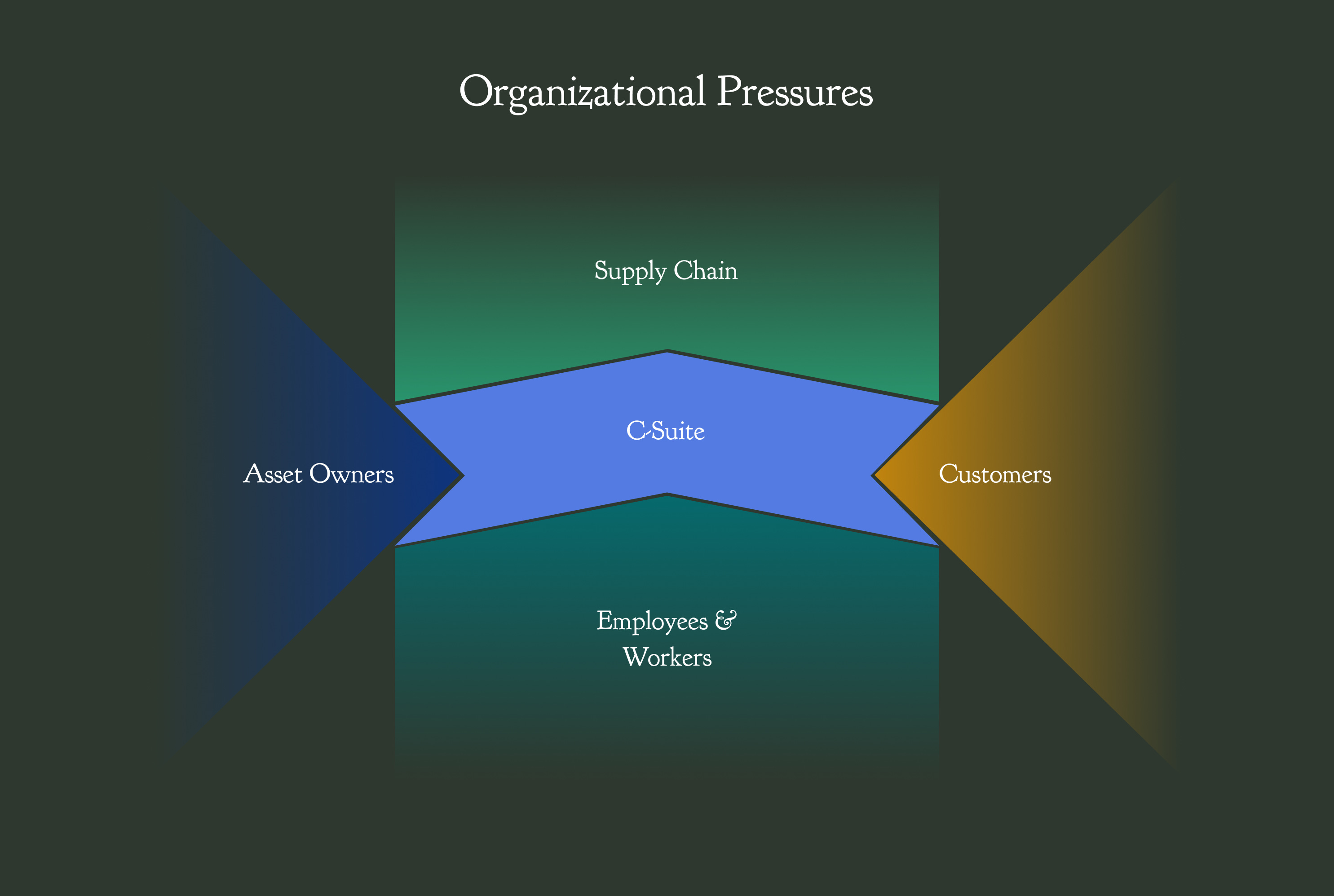
Unfortunately, this means that companies are now beholden to their owners. The majority stock holders. The more you own, the more you can dictate how a company operates.
The prices to set, the strategies to employ, and the wages to provide.
It goes without saying, the power that comes from the equity owners side is immense. You paid the “market price” to own a part of this company, and it is in your best interest to work towards increasing the value of the portion you bought.
To make sure that this mandate - and the actions undertaken to achieve it - stay reasonable, don’t harm consumers and the wider economy, and stay moral, we have developed complex regulatory structures.
Elected officials from the Federal Trade Commission, the Securities and Exchange Commission, the Internal Revenue System, the Fed, and various other bodies make sure of this every day.
On the employee and consumer end, the ability and power to effect change on the operating organization may be limited, but the Consumer Protection Courts, the Food and Drug Administration, the Social Security Commission, and the Department of Labor make sure we are protected.
In addition, to amplify the voice of the employee, we also have labor unions, pay transparency laws, and legal protection for activities like having conversations about your compensation with a colleague.
Underpinning all this structure is the willingness of the employee to understand this system, participate, and provide much needed balancing actions that keep the economy growing sustainably for everybody.
The good news is that on some level, this system does work. High interest rates, inflation, deflation, market corrections - these are all events that occur in response to everything going in the world.
The Compensation Conversation
First and foremost, valuing your time and your skills starts with qualifications.
Today more than ever, it is true that a qualification like a college degree fails to capture a person’s full potential, or their skills.
The fact remains, however, that being certified to operate in your field, at varying levels, does still stand as proof of your competence.
Experience plays a big role as well. Study or plain understanding cannot replace practical application. In almost all jobs, a significant component involves understanding a system; and how to fix it when it breaks. You only really learn this by doing.
In many ways, this tendency to work together as a species has bound us through time. Humans are pack animals, and our sheer numbers are our strength. Industry and civilization go hand in hand.
With the appropriate qualification, backed by the appropriate experience, we can begin to value our industry and its offerings - and find the major players.
Due to the nature of competing interests in an industry, experience at a competitor in the same domain points to an increased familiarity of the problem space, and is desirable to employers.
The third aspect of valuing your work is time. Depending on your domain, flexibility of time is expected at very different thresholds. But it is true that more flexibility comes expected, seldom less. Conversations around paid time off, accommodations for sickness, benefits for commuting, all play a role.
Though these might seem like they should be an afterthought, at the end of the day, any time spent away from the organization is lost opportunity cost that will be factored in when they draw up your contract.
Granted, the above applies mostly to long term, salaried positions. Unfortunately, I can’t speak to contract based roles.
Next, we have growth.
As part of an organization, every employee is valued according to an evolving valuation of the whole.
This is why it’s important to understand your growth relative to the organization.
Over the course of a year, do you understand the system better? Does your work have fewer mistakes, more foresight?
Do you make better decisions? Mostly, humans tend to get better over time, improving with practice and learning. In this case, is your compensation being valued higher than it was a year ago?
Has the organization as a whole suffered any setbacks? Have there been problems within the business? Lost revenue, and as a result, a lower stock price?
Have there been wider socio-economic conditions to consider? Inflation, or deflation?
Lower valuations typically mean lower compensation values, at least for the C-Suite.
In most organizations, stock is a significant part of the compensation package for executives and higher. This is to ensure that their compensation remains tied, at least in part, to the performance of the organization. Skin in the game.
However, for most employees, stock is either not a part, or an insignificant part of their compensation.
This is why we need to look out for the oft heard refrain “Your raise is on hold/limited because the company didn’t perform well this year.”
Make sure your raise, or bonus component, is individual performance based, at least in part. You do not have skin in the game.

C-Suite executives and CEOs pocket ever larger paychecks every year. A huge component of their compensation is not contingent on performance.
Here’s an example of the kind of double-speak that exists today:
Exhibit A: “Disney CEO Bob Iger raked in $31.6 million in compensation last year – a multi-million-dollar boost from his income the year before.“
Exhibit B: “In November, Disney said it would slash its expenses by another $2 billion, adding to the $5.5 billion reduction it had previously announced as it looks to rebuild its business in a rapidly changing media environment.
On the company’s fourth quarter earnings call in November, Iger touted the ‘progress’ Disney had made to improve its business, but said there was still work to do.“.
When we talk about startups, however, its slightly different. Since they have less operating capital, and the increased risk of the business failing, they do offer atypically high amounts of ownership of the organization to early employees. It’s important to remember that these are usually RSUs, or Restricted Stock Units.
These are effectively worthless unless the organization eventually starts issuing stock and begins trading on a recognized exchange. It’s impossible to really know how much those RSUs could end up being worth.
It could be nothing. Decide accordingly.
The last, and most visible part of your compensation will be a paycheck. A pre-determined, regular cash component that we can actually quantify and analyze.
Companies are incentivized by design to optimize for the needs of the majority shareholders, due to the legal structure of the C-Corp.
Negotiate, be aware of ongoing changes in your industry, and if needed, take your talents elsewhere. The competition will value you more than your employer.
Outro
It’s up to us to take part in making sure we are being paid what we are worth. That we’re given enough time to live our lives. That the protections meant to be in place do not fail those of us with less when it comes to it.
Negotiating and reputation will be valuable tools, but never stop being aware of your position, the options available to you, and make sure you continue to be valued what you are worth.
Thanks for reading, see you next time.
Voiceover
Disclaimer: The information provided in this newsletter is for educational and informational purposes only. It is not intended as and should not be considered financial, investment, or legal advice. The content is general in nature and may not be applicable to your specific circumstances. Always consult with a qualified professional for advice tailored to your individual situation. The authors and publishers of this newsletter are not financial experts, and any actions taken based on the information presented are at the reader's own risk. We do not endorse or recommend any specific financial products or services. Any reference to third-party websites or products does not constitute an endorsement. The accuracy, completeness, or reliability of information provided cannot be guaranteed. Readers are encouraged to conduct their own research and seek professional advice if needed.